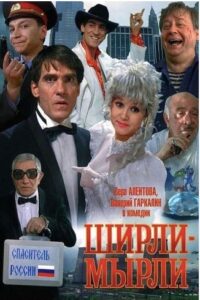
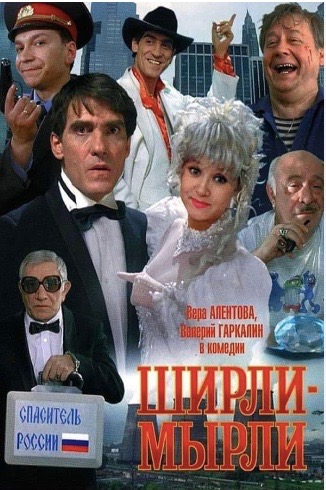
When a diamond 💎 whose size is unhoped-for and unthinkable is extracted from a mine in Yakutia, the entire country rejoices !
This unique diamond is soon named the « Saviour of Russia » as it should allow to pay up the entirety of the abyssal national debt and grant every citizen a 3-year vacation in the Canary Islands !
The diamond is carried to Moscow under high protection in an Antonov An-124 aircraft, but without any discretion as the authorities stage the transport in a big fashion.
After its arrival in the capital city, the diamond is stolen by the Mafia godfather Kozioulsky (Armen Djigarkhian), only to be thereafter stolen by Vassily Krolikov (Valery Garkalin), a well-known crook.
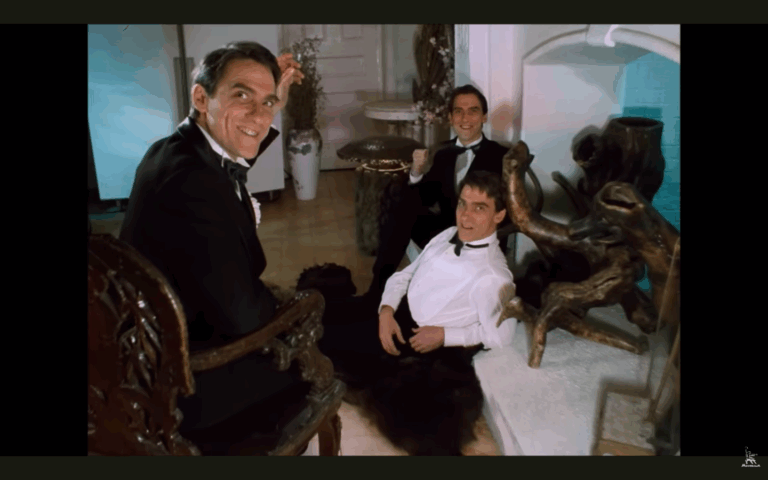
As he is the object of the pursuit by both the police (милиция) and Koziulsky’s henchmen, Krolikov encounters his two twin brothers : one has been raised in a Jewish family and became an esteemed conductor, the other one is raised in a family of Russian gipsies and runs for a seat in the parliament.
It’s not longer one man, but rather three brothers that have both the authorities and the mafia on their heels. There starts a chain of quiproquos and burlesque throughout the movie.
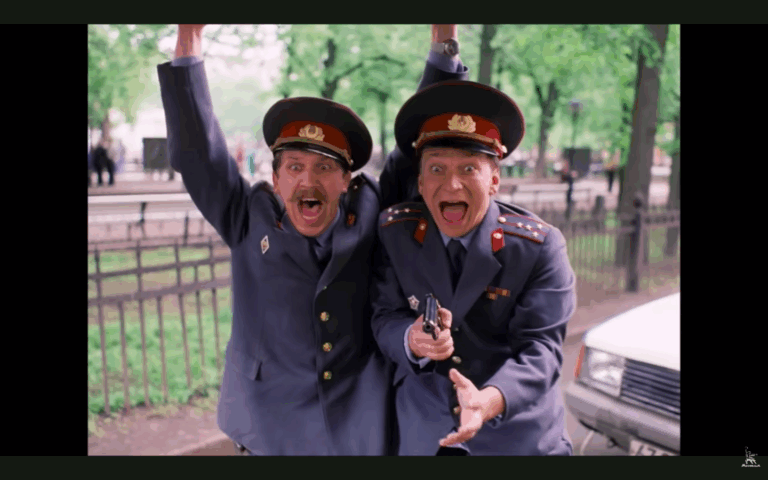
But what got into Vladimir Menshov, the Oscar-winning director in 1981 for “Moscow does not believe in tears”, to release in 1995 such a production bringing together many renowned actors?
With its assumed register of the absurd, “𝘚𝘩𝘪𝘳𝘭𝘪-𝘔𝘺𝘳𝘭𝘪” confused and had not been positively received by critics at its release, as recalled by the program vDud broadcast in October 2021 on the Youtube channel of the same name, in an episode devoted to “𝘚𝘩𝘪𝘳𝘭𝘪-𝘔𝘺𝘳𝘭𝘪”
Although it is now a popular film, laughter was rather rare at its release. Satire was misunderstood. Rather, the public was left with chaos, dubious jokes and rudeness.
The genre of the farce is risky: either it doesn’t strike a cord, or it makes you laugh.
The title of the film itself is difficult to translate. It was chosen by one of the scriptwriters, Vitalii Moskalenko, whose grandmother from the Volgograd region often sang humorous rhymes, and one of them had “𝘚𝘩𝘪𝘳𝘭𝘪-𝘔𝘺𝘳𝘭𝘪” in his chorus.
The character of Krolikov sings it in one of his first appearances. As for the Canary Islands, they represent in the Russian society of the 1990s the ideal of rest and relaxation, more so than the Balearic Islands, the Côte d’Azur or Courchevel.
Vladimir Menshov later said that he wanted to portray the disorganised and chaotic Russia of the 1990s, and wanted to make a movie about friendship.
The themes of chauvinism, anti-Semitism and racism are evoked with humor and lucidity. Each of the three brothers initially evokes hostility, if not an aversion, for at least one of the other two.
Thus the Russian towards the Jew, the Jew towards the Gypsy, and the Gypsy towards the Russian.
In order to allow Valery Garkalin to take turns interpreting the three brothers, sometimes present in the same scene and, not yet benefiting from the most modern technologies, the director was inspired by techniques used in the 1947 film, “The Spring”, by Grigori Alexandrov.
To shoot these scenes alone, a month of filming was necessary. For this role, Valery Garkalin received the 1995 Best Actor Award at the Kinoshock festival in Anapa, an event dedicated to the cinema of the Commonwealth of Independent States (CIS).
He will also be distinguished Artist Emeritus of the Russian Federation in 2000, then Artist of the People of the Russian Federation in 2008. He died of Covid-19, at the age of 67, in November 2021, four months after Vladimir Menshov, who also died of Covid-19 at the age of 81.
Mainly covered by taiga and mountainous areas, Yakutia, also known as the Republic of Sakha, is located in the northeast of Siberia. With more than 3 million km2, it is the largest subject of the Russian Federation. Since the discovery of the first diamond deposit in the 1950s, activity has continued to grow, and now represents more than 95% of national raw diamond production. Once the world’s leading producer of diamonds, Russia now represents more than 30% of world production.
In October 2019, for the first time in the world, a diamond containing another diamond in its heart was discovered in Siberia.
For the anecdote, the largest diamond ever extracted from a Russian mine to date was discovered in Yakutia in May 2025. Named “80 years of the Victory of the Great Patriotic War”, amber in color, it weighs 468 carats. The world’s largest raw diamond ever mined remains Cullinan (3106 carats, about 620 grams), extracted from a mine in South Africa in 1905.
Some lines of the film have become popular. Thus, when his mother explains to him that she is actually his aunt and that he has a twin brother, Krolikov puts his mother’s words on fatigue and advises her to pay attention to her diet:
“Mom, cabbage is good, but you also need meat snacks at home”.
The expression “He sells wooden members! ” was misunderstood at the time by many Russians. Vladimir Menshov evoked here the matrioshkas, these wooden nesting Russian dolls painted with the image of the members of the Central Committee of the Communist Party of the Soviet Union. Sold in the streets of the capital, they were popular with foreign tourists in the 1980s and 1990s.
The absence of artistic censorship gives the director, for the first time, total freedom. Indeed, for his previous films, including “Moscow does not believe in tears” (1980) or “Love and pigeons” (1985), the authorities had intervened. But the Russian film production of the 1990s is not favored, however, the economic, political and security context lending itself little to state subsidies and a film policy (economic collapse of the early 1990s, bombing and storming of Parliament by the army in October 1993, First Chechen War…).

Thus, the alcoholic character of Sukhodrichev, played by Oleg Tabakov (a figure of the Sovremennik theater, whose troupe was created in 1956 at the time of Khrushchev’s thaw), can afford to shout in front of the police:
“Stop the torture, we are no longer in 1937! “.
The screenwriters also included, to accompany the television presenter (played by Arkady Koval) announcing the good news (the discovery of the diamond), then the bad news (the theft of the diamond), an interpreter in sign language, who had no visibility on Soviet screens.
The words of “Ah, you, vast steppe“, performed by the Kuban Cossack Choir, accompany the last minutes of the film, which was very little broadcast abroad. In France, the Russian Orthodox Spiritual and Cultural Center in Paris organized a screening last spring. « Shirli-Myrli” is available on the Youtube platform.